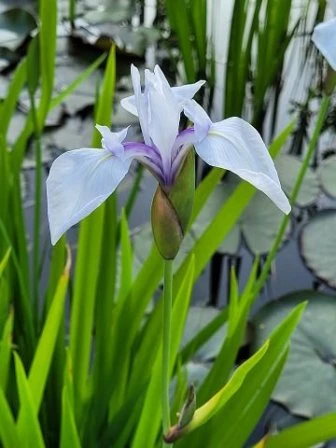
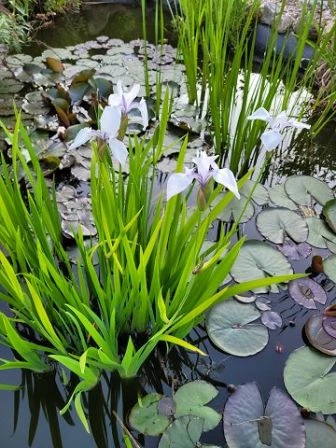
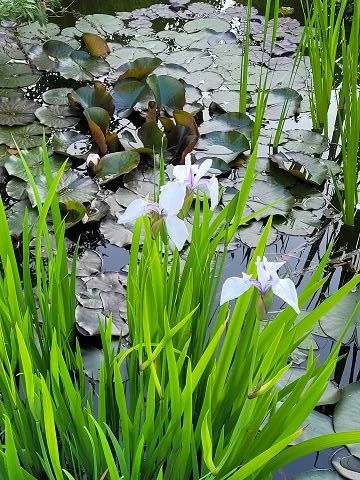
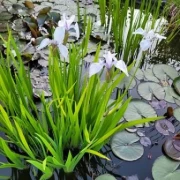
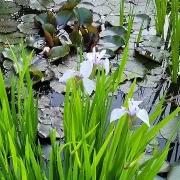

The water iris (scientific name: Iris pseudacorus), also known as yellow iris, is a striking aquatic plant in the iris family (Iridaceae). However, there are also purple-flowering species that are often cultivated in gardens and ponds.
Characteristics:
Growth form: The water iris is a perennial plant that typically reaches a height of 60 to 120 cm. It has upright, sword-shaped leaves that can grow up to 90 cm long.
Leaves: The leaves are narrow, long and green, with a characteristic pointed shape. They grow in dense clusters.
Flowers: The flowers appear in late spring to early summer (May to June) and are striking. In purple-flowering varieties, the flowers are usually deep purple or lavender with yellow or white accents. The flowers have three outer bracts and three inner petals that open in a characteristic shape.
Fruits: After flowering, elongated capsules containing the seeds form.
Location and care:
Light: Water irises prefer sunny to partially shaded locations. They need sufficient light for lush flowering.
Soil: These plants thrive best in moist to wet soil, ideally near bodies of water or in swampy areas. They can also stand in shallow water.
Watering: Since they prefer moist conditions, it is important that the soil remains evenly moist.
Use:
Ornamental plant: Water irises are often used in garden ponds, wet biotopes and as ornamental plants in perennial beds. Their striking flowers make them a popular choice for natural gardens.
15 seeds available