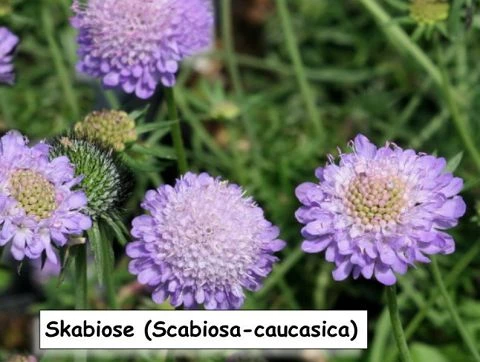
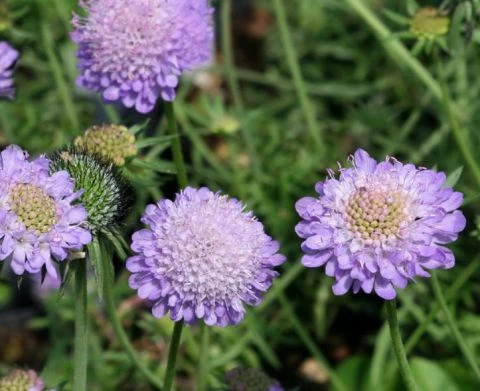
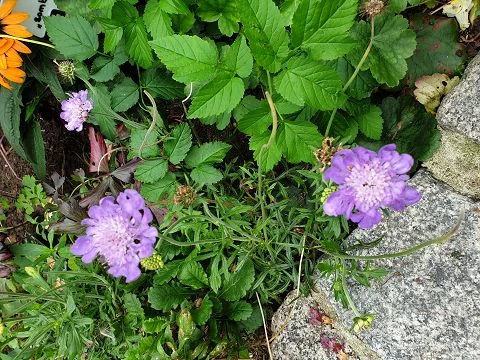
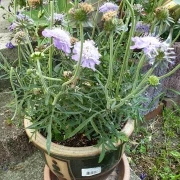
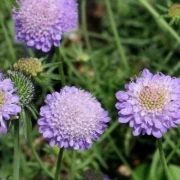
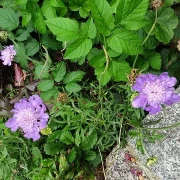

The scabiosa, scientifically known as Scabiosa caucasica, is a perennial plant in the honeysuckle family (Dipsacaceae). It is known for its striking flowers and long flowering period.
Characteristics:
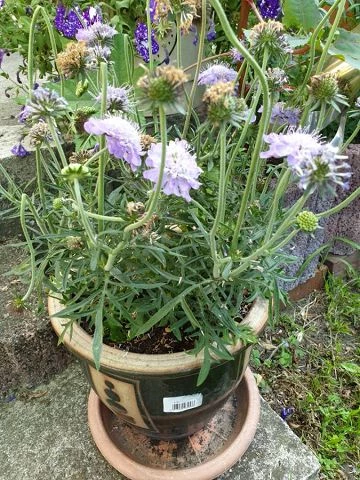
Growth form: Scabiosa caucasica reaches a height of about 30 to 60 cm. The plant has an upright growth and often forms dense clumps.
Leaves: The leaves are pinnate, lanceolate to oval and are green in color. They grow in a rosette at the base of the plant and are usually arranged alternately on the stem.
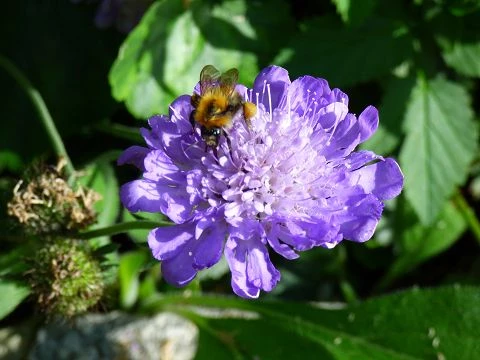
Flowers: The flowers appear in round or umbrella-like umbels and are usually blue, purple or white. Each flower has a characteristic shape with many small individual flowers that together form a large flower. The flowering period is from June to September.
Location and care:
Light: Scabiosas prefer sunny locations, but can also thrive in slightly shady areas.
Soil: They thrive best in well-drained, nutrient-poor soil. A sandy or loamy soil is ideal.
Watering: During the growing season, the plant needs regular watering, but should not be left standing in water. It is relatively drought-resistant.
Propagation:
Propagation is by seeds, which can be sown in spring. Alternatively, the plant can also be propagated by division.
Use:
Ornamental plant: Due to its attractive flowers, the scabiosa is often used as an ornamental plant in gardens. It is well suited to perennial beds, borders and wildflower meadows.
Cut flower: The flowers are also popular as cut flowers and keep well in a vase.