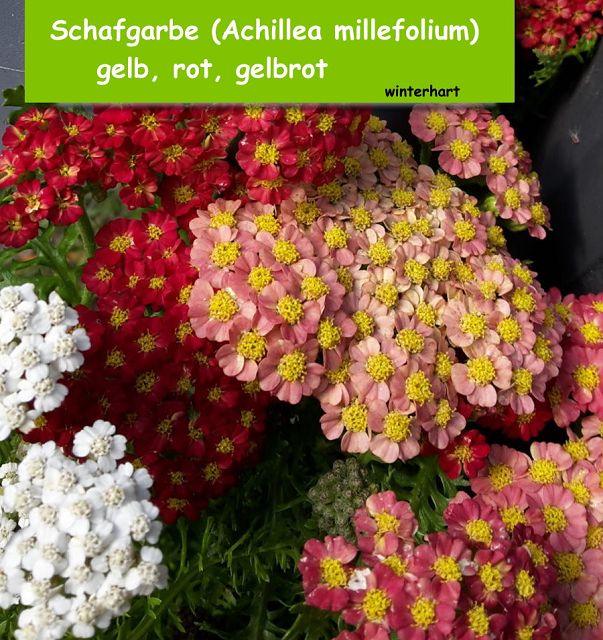

Yarrow, scientifically known as Achillea millefolium, is a perennial plant in the daisy family (Asteraceae). It is known for its medicinal properties and the variety of its flower colors. There are many varieties and cultivars that bloom in different colors such as yellow, red and yellow-red. Characteristics: Growth form: Yarrow reaches a height of about 30 to 100 cm. It has an upright growth and often forms dense stands. Leaves: The leaves are pinnate, narrow and green to gray-green. They grow alternately on the stem and can be up to 15 cm long. Flowers: The flowers appear in flat umbels or umbels and are available in various colors, including yellow, red and yellow-red. The flowering period is from May to September. Location and care: Light: Achillea millefolium prefers sunny locations, but can also thrive in partial shade. Soil: It grows best in well-drained, nutrient-poor soil. A sandy or loamy soil is ideal.
Watering: Yarrow is relatively drought-resistant, but requires regular watering during the growing season.
Propagation:
Propagation is by seed or vegetative division. Sowing can be done in spring or autumn.
Uses:
Ornamental plant: Due to its beautiful flowers, yarrow is often used in perennial beds, wildflower meadows and as a cut flower. It attracts pollinators such as bees and butterflies.
Medicinal plant: In traditional medicine, yarrow is valued for its anti-inflammatory and healing properties. It is often used to treat wounds, digestive problems and menstrual cramps.