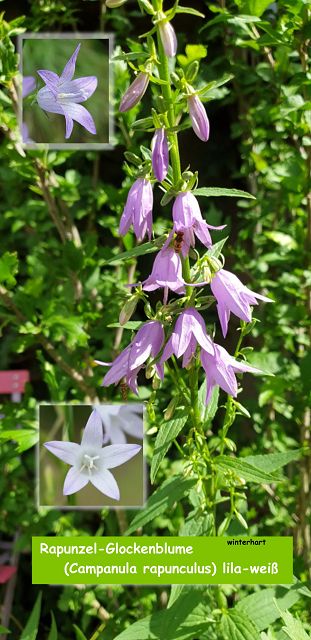

The Rapunzel bellflower, scientifically known as Campanula rapunculus, is a perennial plant in the bellflower family (Campanulaceae). It is best known for its attractive flowers and characteristic growth. Characteristics: Growth form: Campanula rapunculus reaches a height of about 30 to 80 cm. The plant has an upright growth and often forms dense stands. Leaves: The leaves are elongated to oval, green and can reach a length of up to 15 cm. They usually grow basally and along the stem. Flowers: The flowers are funnel-shaped and appear in clusters at the upper ends of the stems. They are typically purple or white, with the purple variant being particularly striking. The flowering period is from May to August. Location and care: Light: The Rapunzel bellflower prefers sunny to partially shaded locations. Soil: It thrives best in well-drained, humus-rich soil. A slightly calcareous soil is also well tolerated.
Watering: During the growing season, the plant needs regular watering, but should not be left standing in water.
Propagation:
The Rapunzel bellflower can be propagated by seed or vegetative propagation (e.g. by division). Sowing is best done in spring or autumn.
Uses:
Ornamental plant: Due to its beautiful flowers, the Rapunzel bellflower is often used in gardens, perennial beds and as a cut flower. It also attracts pollinators such as bees and butterflies.
Edible plant: The young leaves and roots of the Rapunzel bellflower are edible and can be used in salads or as a vegetable.