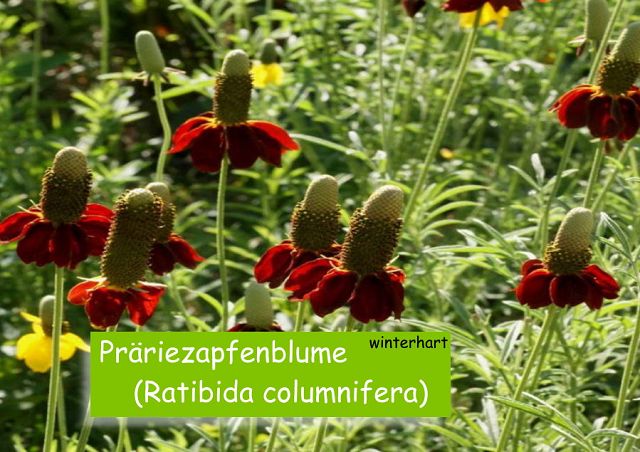

The prairie cone flower, scientifically known as Ratibida columnifera, is a perennial plant in the Asteraceae family. It is found mainly in the prairies and open landscapes of North America and is characterized by its striking flowers and robust growth. Characteristics: Growth form: Ratibida columnifera reaches a height of about 30 to 90 cm. The plant has an upright, branched growth. Leaves: The leaves are pinnate or deeply dissected and usually grow basally and along the stem. They are green and can reach a length of up to 20 cm. Flowers: The flowers appear in a characteristic, cone-shaped inflorescence. The outer petals are yellow and radiate around the central, tubular flower, which is brown or reddish brown. The flowering period is from June to September. Location and care:
Light: The prairie cone prefers sunny locations and needs plenty of light for optimal growth.
Soil: It thrives best in well-drained, sandy or loamy soils. The plant is adaptable to various soil types as long as drainage is good.
Watering: Ratibida columnifera is drought tolerant and only requires regular watering during the first few years of growth.
Propagation:
The prairie cone can be propagated by seed. Sowing is best done in spring or fall.
Uses:
Ornamental plant: Due to its attractive flowers, the prairie cone is often used in gardens, wildflower beds and as a cut flower. It also attracts pollinators such as bees and butterflies.
Wild plant: In its natural habitat, it contributes to biodiversity and provides habitat for various animal species.