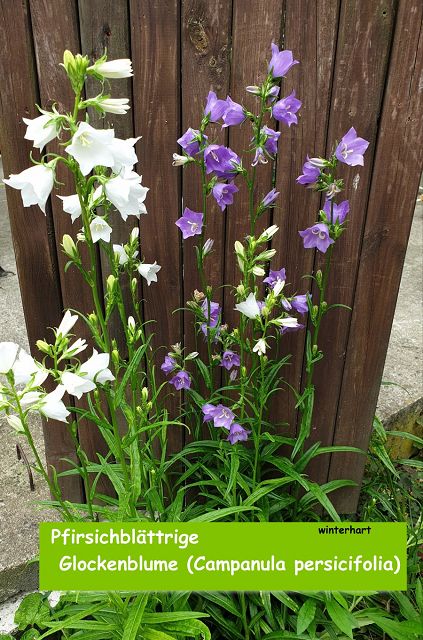

The peach-leaved bellflower, scientifically known as Campanula persicifolia, is a perennial plant in the bellflower family (Campanulaceae). It is known for its elegant, bell-shaped flowers and attractive foliage.
Characteristics:
Growth form: Campanula persicifolia reaches a height of about 30 to 100 cm. It has an upright growth and often forms dense stands.
Leaves: The leaves are lanceolate to elliptical and their shape is reminiscent of peach leaves, which gives the plant its name. They are green and can reach a length of up to 15 cm. The leaves are usually arranged basally.
Flowers: The flowers are bell-shaped and appear in grape-like inflorescences. They bloom in various colors, mainly blue, purple or white. The flowering period is from May to July.
Location and care:
Light: Campanula persicifolia prefers sunny to partially shaded locations.
Soil: The plant grows best in well-drained, humus-rich soils. However, it is adaptable and can also thrive in less fertile soils.
Watering: During the growing season, the peach-leaved bellflower requires regular watering, especially in dry periods.
Propagation:
The peach-leaved bellflower can be propagated by seed or vegetative propagation (e.g. by division). Sowing is best done in spring or autumn.
Use:
Ornamental plant: Due to its attractive flowers, the peach-leaved bellflower is often used in gardens, borders and as a cut flower.
Wild plant: In some regions it is also valued as a wild plant and contributes to biodiversity.