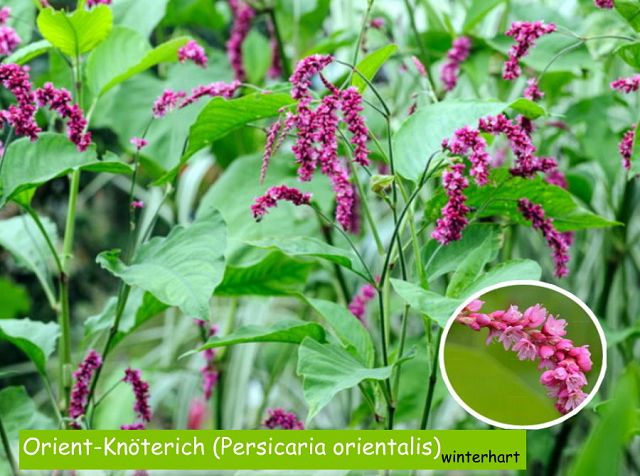

Oriental knotweed, scientifically known as Persicaria orientalis, is a perennial plant in the knotweed family (Polygonaceae). This plant is known for its striking flowers and attractive foliage.
Characteristics:
Growth form: Oriental knotweed can reach a height of 1 to 2 meters. It has an upright growth habit and often forms dense stands.
Leaves: The leaves are large, oval to lanceolate and can reach a length of up to 15 cm. They are green and often have a slightly shiny surface.
Flowers: The flowers appear in long, upright clusters and are usually pink to red in color. They bloom from summer to autumn (July to September) and attract many pollinators such as bees and butterflies.
Location and care:
Light: Persicaria orientalis prefers sunny to partially shaded locations.
Soil: The plant grows best in moist, well-drained soil, but can also thrive in less fertile soil.
Watering: It requires regular watering, especially during dry periods. However, waterlogging should be avoided.
Propagation:
Oriental knotweed can be propagated by seed or vegetative propagation (e.g. by division). Sowing is best done in spring.
Uses:
Ornamental plant: Due to its attractive flowers, Oriental knotweed is often used in gardens, borders and as a cut flower.
Edible plant: In some cultures, the young leaves and shoots are used as a vegetable.