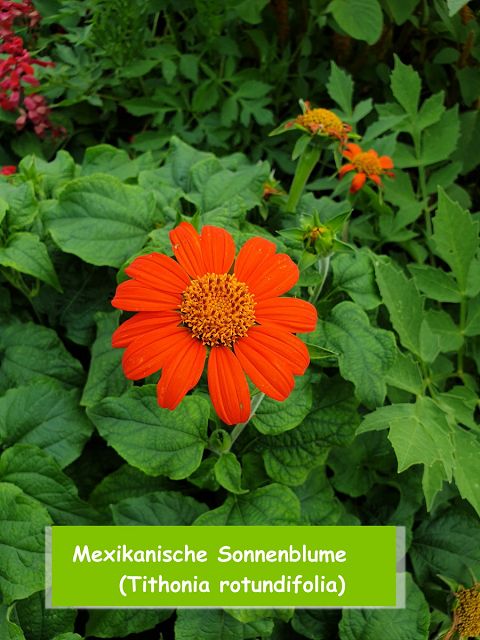

The Mexican sunflower, scientifically known as Tithonia rotundifolia, is a striking flowering plant in the daisy family (Asteraceae). It is known for its bright orange to yellow flowers and its robustness. H
Characteristics:
Growth form: Tithonia rotundifolia is an annual plant that can typically reach a height of 1 to 2 meters. It has an upright growth habit and often branches.
Leaves: The leaves are large, rounded to ovate and have a rough texture. They are green and can grow up to 20 cm long.
Flowers: The flowers are radial and appear in bright colors ranging from orange to yellow. They usually bloom from summer to autumn (July to October) and attract many pollinators such as bees and butterflies.
Location and care:
Light: The Mexican sunflower needs a sunny location to thrive optimally.
Soil: It prefers well-drained, nutrient-rich soils, but can grow in less fertile soils.
Watering: Regular watering is recommended during the growing season, especially during dry periods. However, the plant is relatively drought tolerant once established.
Propagation:
The Mexican sunflower can be propagated by seed. Sowing is best done in spring after the last frost.
Uses:
Ornamental: Due to its striking flowers, the Mexican sunflower is often used in gardens, borders and as a cut flower.
Bee-friendly: The plant attracts pollinators and contributes to biodiversity in the garden.