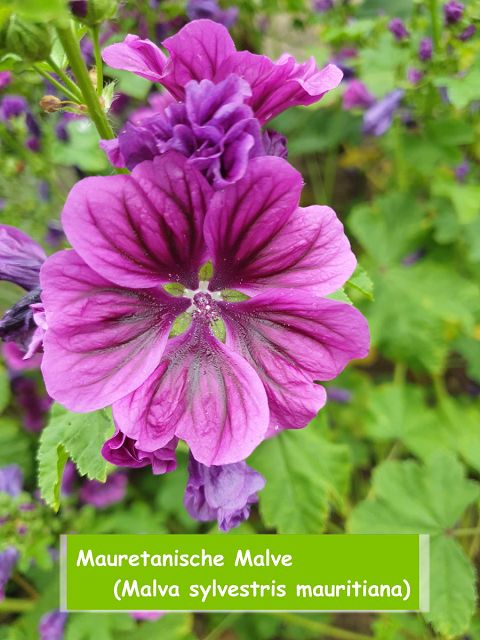

The Mauritanian mallow, scientifically known as Malva sylvestris mauritiana, is a subspecies of the common mallow (Malva sylvestris) and belongs to the mallow family (Malvaceae). This plant is known for its attractive flowers and its versatile uses.
Characteristics:
Growth habit: The Mauritanian mallow is a perennial plant that typically reaches a height of 30 to 100 cm. It has an upright habit and can spread by runners.
Leaves: The leaves are palmate, deeply dissected and green in color. They are often hairy and may have a slightly serrated edge.
Flowers: The flowers are large and showy, usually in various shades of pink to purple. They appear in racemose inflorescences in the summer months (June to September).
Location and care:
Light: The Mauritanian mallow prefers sunny to partially shaded locations.
Soil: It grows best in well-drained, nutrient-rich soil, but can also thrive in less fertile soil.
Watering: During the growing season, the plant requires regular watering, but is relatively drought-resistant once established.
Propagation:
The Mauritanian mallow can be propagated by seed or division. Sowing is best done in spring or autumn.
Uses:
Culinary: The leaves and flowers of the mallow are edible and can be used in salads or as a vegetable. They have a mild flavour.
Medicinal: In traditional medicine, the mallow is valued for its anti-inflammatory and expectorant properties. It is often used for respiratory diseases or skin irritations.
Ornamental: Due to its beautiful flowers, the Mauritanian mallow is often used in gardens as an ornamental plant.