
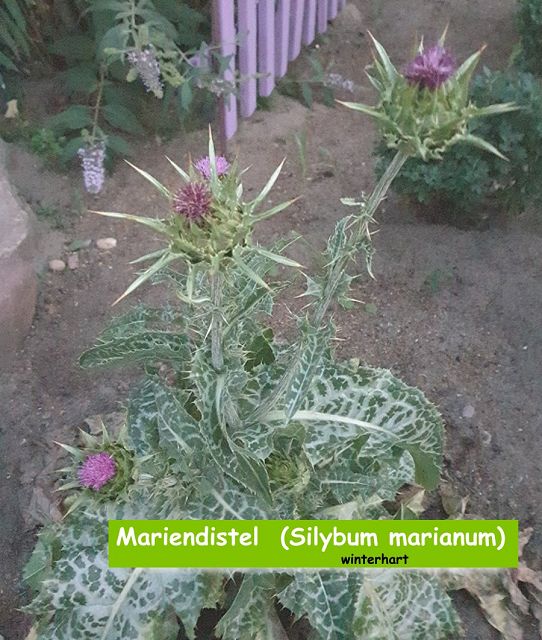

Die Mariendistel, wissenschaftlich als Silybum marianum bekannt, ist eine Pflanzenart aus der Familie der Korbblütler (Asteraceae). Sie ist für ihre auffälligen Blüten und ihre medizinischen Eigenschaften bekannt.
Merkmale:
Wuchsform: Die Mariendistel ist eine mehrjährige Pflanze, die eine Höhe von 1 bis 2 Metern erreichen kann. Sie hat einen aufrechten Wuchs und bildet oft dornige Blätter.
Blätter: Die Blätter sind groß, grün und haben eine charakteristische weiße Marmorierung. Sie sind gezähnt und können bis zu 30 cm lang werden.
Blüten: Die Blüten erscheinen in großen, kugeligen Köpfen und sind meist purpurfarben oder rosa. Die
Blütezeit reicht von Juni bis September.
Standort und Pflege:
Licht: Die Mariendistel bevorzugt sonnige Standorte.
Boden: Sie wächst am besten in gut durchlässigen, nährstoffreichen Böden, kann aber auch in weniger fruchtbaren Böden gedeihen.
Bewässerung: Die Pflanze benötigt regelmäßige Bewässerung, besonders während trockener Perioden, ist jedoch relativ trockenheitsresistent, sobald sie etabliert ist.
Vermehrung:
Die Mariendistel kann durch Samen vermehrt werden. Die Aussaat erfolgt am besten im Frühjahr oder Herbst.
Verwendung:
Medizinische Anwendung: Die Mariendistel wird häufig in der traditionellen Medizin verwendet, insbesondere wegen ihrer leberunterstützenden Eigenschaften. Der Hauptbestandteil mit gesundheitlichen Vorteilen ist Silymarin, ein Extrakt aus den Samen der Pflanze.
Zierpflanze: Aufgrund ihrer auffälligen Blüten wird die Mariendistel auch als Zierpflanze in Gärten und Landschaften verwendet.
Besonderheiten:
Die Mariendistel ist nicht nur für ihre medizinischen Eigenschaften bekannt, sondern auch für ihre Fähigkeit, sich an verschiedene Umweltbedingungen anzupassen. Sie ist eine robuste Pflanze, die in vielen Regionen gedeiht und oft in Wildblumenwiesen oder naturnahen Gärten zu finden ist. In einigen Gebieten kann sie invasiv sein, daher sollte man beim Anbau darauf achten.